From Opinion to Accountability: How Paper and Spreadsheets Create Coaching Clarity Gaps
Meta Description: Paper and spreadsheets are killing accountability in sports programs. Learn how moving from disconnected records to centralized, mobile-friendly data clarifies tough conversations, identifies real leaders, and supports coaching decisions with facts.
Date of creation: 2026-08-16
Industry Focus: High School Athletics • Basketball • Youth Academies • Coaching & Operations
The Problem: The High Cost of the Unknown
It's 4:00 PM on a Wednesday. The varsity basketball coach is finalizing next week's practice plan when a parent walks in, looking for a "tough conversation."
"My son isn't getting enough playing time. We feel it's based on opinion, not fairness. The memory of last year's performance isn't accurate."
The coach is blindsided. In his mind, the reason is clear: the player has missed two key defensive practices, often shows up late to weight lifting, and his recent "effort scores" on transition defense have plummeted.
But when the coach reaches for evidence, he faces a nightmare:
- Daily Attendance: It's tracked on a tattered paper clipboard. If it's not missing, the ink is smudged.
- Work Tracking: His assistant coaches have notes in their own notebooks, but they aren't consolidated.
- Identifying Leaders: He remembers who worked the hardest, but that memory is fuzzy when challenged by an angry parent.
- Measuring Improvement: The only recent metric is in a messy spreadsheet on his phone, which he can't find right now.
The conversation that should have been data-backed and objective becomes an emotionally charged back-and-forth about opinions and memory. The coach leaves feeling undermined, and the player learns nothing.
This is the hidden crisis in sports leadership today: The Accountability and Decision-Making Gap created by outdated systems.
The Anatomy of Operational Chaos
For decades, coaching staffs relied on pen, paper, and physical binders to run their operations.
In the past, this was enough.
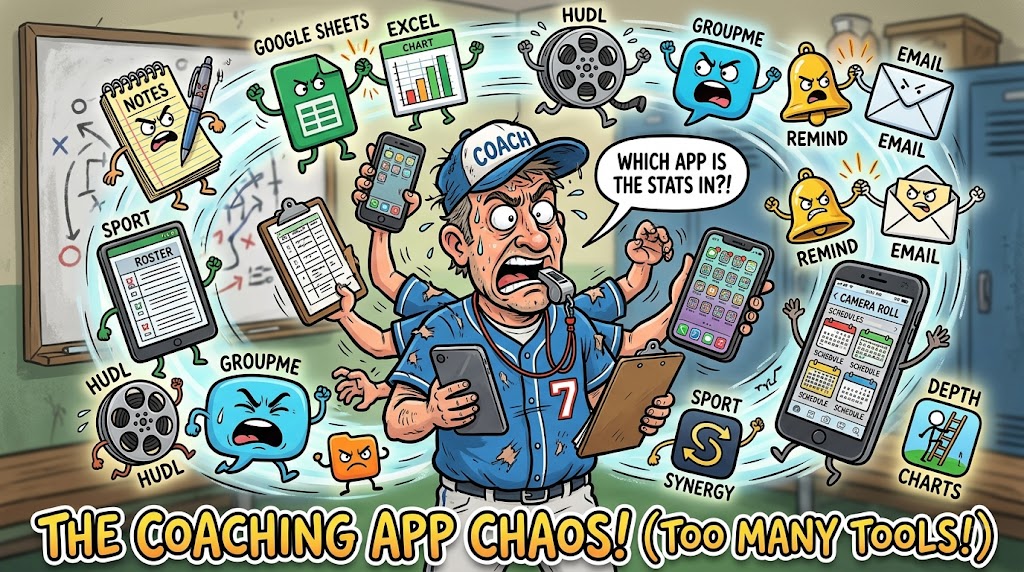
But today, the demands of performance tracking, parent communication, and split-second game strategy have overwhelmed analog systems. The resulting fragmentation looks like this:
- Daily attendance is recorded on a paper clipboard that disappears.
- Tracking individual work is an empty promise—notes are made, but rarely collated.
- Documentation of effort/discipline is opinion-based or memory-based.
- Records are locked away in a drawer when critical coaching decisions are being made on the phone, tablet, or in a meeting.
- In-game stats are jotted down on paper charts, but they are too slow to inform strategy before the next series or defensive set.
When critical information is disconnected, decision-making suffers. Every decision feels like an opinion.
The Real Cost of Missing Data
Outdated tracking systems aren't just a matter of operational friction. They have a measurable, negative impact on team dynamic and athletic development.
1. Zero Accountability
When players know their presence, effort, or absence isn't officially recorded, consistency drops. Accountability requires certainty.
2. Difficulty in Identification
Without historical records, identifying your true leaders—the players who consistently work hardest, not just the loudest—is impossible. True leaders are defined by accumulated data, not singular moments.
3. Decisions Based on Emotion and Memory
The most damaging outcome is decision-making. When a coach makes a tough call (cutting a player, demoting a starter, determining playing time) without data, that decision is viewed as biased, temporary, or unfair.
4. Zero Real-Time Feedback Loop
Coaches need to adjust strategy now. A paper chart of in-game offensive efficiency doesn't help you adjust before the third quarter begins. By the time you find the chart, the game is over.
Example: Moving to an Integrated Accountability Hub
Imagine that same 4:00 PM Wednesday parent meeting, but the coach has implemented a mobile-friendly operational hub.
Before the parent sits down, the coach pulls up the player's profile on his tablet.
With one tap, he displays:
- Consolidated Daily Attendance: A clear, undeniable record of every missed or late practice and weight session.
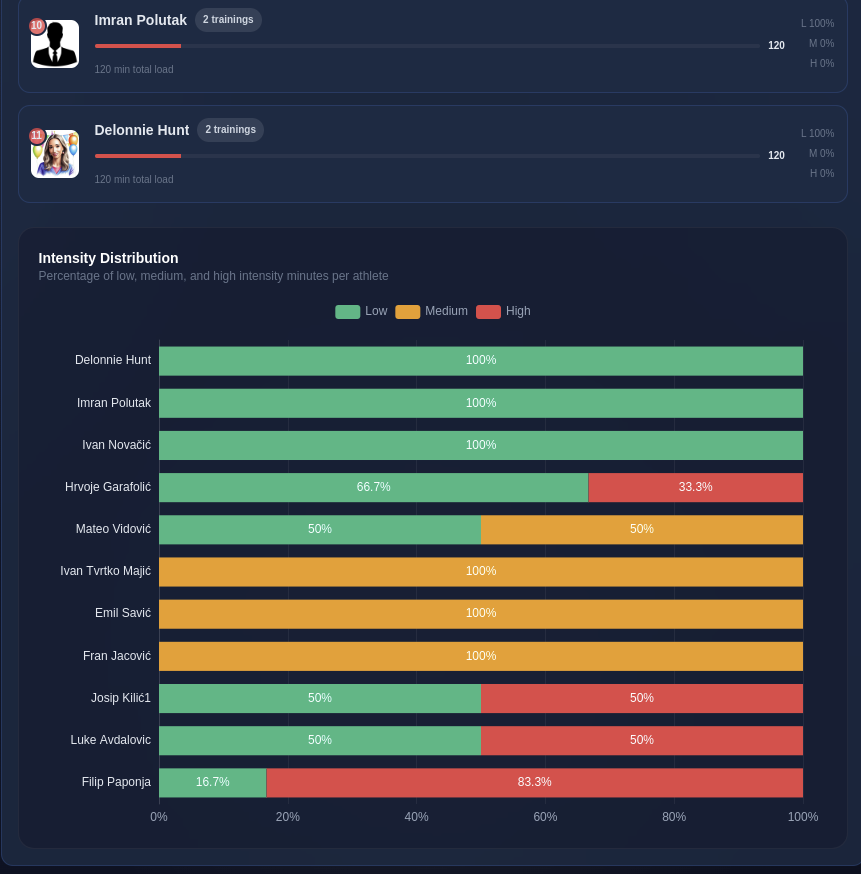
- Automated Leaderboards: The player's ranking in effort scores compared to the team, highlighting specific gaps in consistency.
- Daily Work Tracking: Consolidated notes from all assistant coaches regarding tactical understanding and specific training session feedback.
- Documented Improvement (or lack thereof): Specific metrics (shooting efficiency, defensive rotation scores) tracked over six weeks.
The conversation changes completely.
The coach doesn't have to defend his opinion; he demonstrates the reality. The parent is presented with clear, objective documentation. The discussion shifts from "You don't like my son" to "The data shows exactly what your son needs to improve to earn more minutes."
Clarity replaces confusion. Facts replace memory.
How ClubMeter Unifies Operations and Clarifies Decisions
The goal isn't just to replace paper with digital screens.
The goal is to connect the entire operation.
This is where a unified platform like ClubMeter excels. It isn't just a calendar or a roster app; it's an integrated ecosystem that unifies every aspect of program management in one hub, accessible from any device.
By using ClubMeter, your staff can:
- Automate Daily Attendance: Use mobile-friendly check-ins that instantly update a centralized database, visible to the whole staff.
- Record Daily Work and Effort: Instantly log effort scores or training notes attached directly to the player's unified profile.
- Generate Instant Reports & Leaderboards: Leverage automated systems that calculate consistency, identify improvement, and build leaderboards that foster competition and recognize your true leaders.
- Document Accountability: Capture data points regarding discipline, communication, and commitment so they are recorded forever.
- Enable Real-Time In-Game Insights: Move beyond paper charts with fast, mobile data entry that provides staff with real-time insights during the game, allowing for immediate tactical adjustments.
From "Managing Chaos" to "Developing Excellence"
Operational excellence should not be a burden. It should be the foundation of player development.
Coaches did not become leaders to navigate a flurry of disconnected spreadsheets and torn notebook pages. They got into coaching to build winning programs and mentor athletes.
Moving from opinion to data-backed decisions unlocks your staff's focus:
- For the Head Coach: Clear evidence for all difficult conversations, removing emotional bias.
- For Assistant Coaches: Simplified input tools that ensure their daily effort in observing and instructing is immediately captured and collated.
- For Players: Instant feedback on their standing, fostering self-awareness and internal competition.
- For the Entire Program: A shared source of truth that builds trust through consistency and clarity.
By removing the "known gaps," you don't just optimize operations; you optimize your culture.
Key Takeaways
- Disconnected systems create clarity gaps: Relying on paper charts and personal notebooks makes consolidating data impossible when it matters most.
- Opinions and memory fail: You cannot win an argument with an opinion; you win it with verified facts and a clear, undeniable record.
- Real accountability requires visible data: Automating leaderboards, attendance, and effort scores allows players to see exactly where they stand, creating natural accountability.
- In-game stats must be live: Paper charts are historical data. Real-time digital input gives you strategic insights before the game ends.
- Unified hubs enable better decisions: Bringing everything into one mobile-friendly hub, like ClubMeter, supports coaching decisions with a clear record accessible from anywhere.
Conclusion
The era of operational chaos, fueled by a messy tornado of paper and siloed spreadsheets, must come to an end.
Modern athletic programs cannot afford the hidden cost of the unknown. Accountability, development, and winning require centralized, accessible, and undeniable data.
By tracking daily attendance, recording effort, automating leaderboards, and capturing in-game data in one unified operational hub, you move your program from managing chaos to developing excellence.
The result is clarity—for you, your staff, and your players.